BeyondAI: Studies on AI Visibility
BeyondAI is a Batunet brand. The portal publishes studies on which companies and brands AI assistants name in response to real buyer questions, which ones they recommend and which sources they rely on, with data, method and limitations. Batunet designed and built the portal: from taking over the measurement data from METEGEN LEO, the research software Batunet also developed, to study pages and PDF reports in three languages.
The case in one minute.
- Product
- Public study portal on which companies AI assistants name and recommend. A Batunet brand, not a client project.
- Batunet's role
- Product concept, design, development and operation of the portal, including the data contract with the research software.
- Measurement
- METEGEN LEO, developed in-house by Batunet: the research software asks the AI systems the questions, evaluates the answers and delivers each study as a validated package.
- Public since
- 29 October 2026, at beyondai.com.tr.
- Studies at launch
- Eight studies, including coffee machines, hotels in Istanbul, accounting software and travertine imports into the US.
- Languages
- Turkish, German and English. Every study appears in all three versions.
- Outputs
- Study overview, full report and technical documentation on the web; per language, a research report and technical documentation as PDF.
- Technical environment
- Next.js, React, TypeScript, Tailwind CSS, Zod and React-PDF on Node.js. Studies live in a file-based release store, without a database.
An answer is not yet a measurement.
More and more buyers ask an AI assistant before choosing a supplier, a product or a hotel. The answer names only a few companies. Which ones depends on how the question is worded, which system is asked and when.
Anyone who asks for themselves therefore only sees what one system answered at that moment. Whether a company is regularly recommended in its market, which competitors appear alongside it and which sources the answers rely on cannot be read from that.
That takes many questions, several systems, recorded measurement conditions and counting rules that disclose what was counted and what was not. This is exactly what BeyondAI sets out to make public and traceable.
What BeyondAI examines.
Each study defines questions that customers in a specific market might ask, and examines the answers of several AI systems. It counts separately which companies are merely named, which are recommended as an option, and which sources the answers cite.
This shows which providers a buyer encounters for a given question, how much the systems differ and how the picture shifts when the question is asked differently. Companies active in a studied market can place their own position and that of their competitors.
The results are neither market shares nor quality judgments about the companies named. Each study states the measurement date, systems, target market and question language, and explains its limitations.
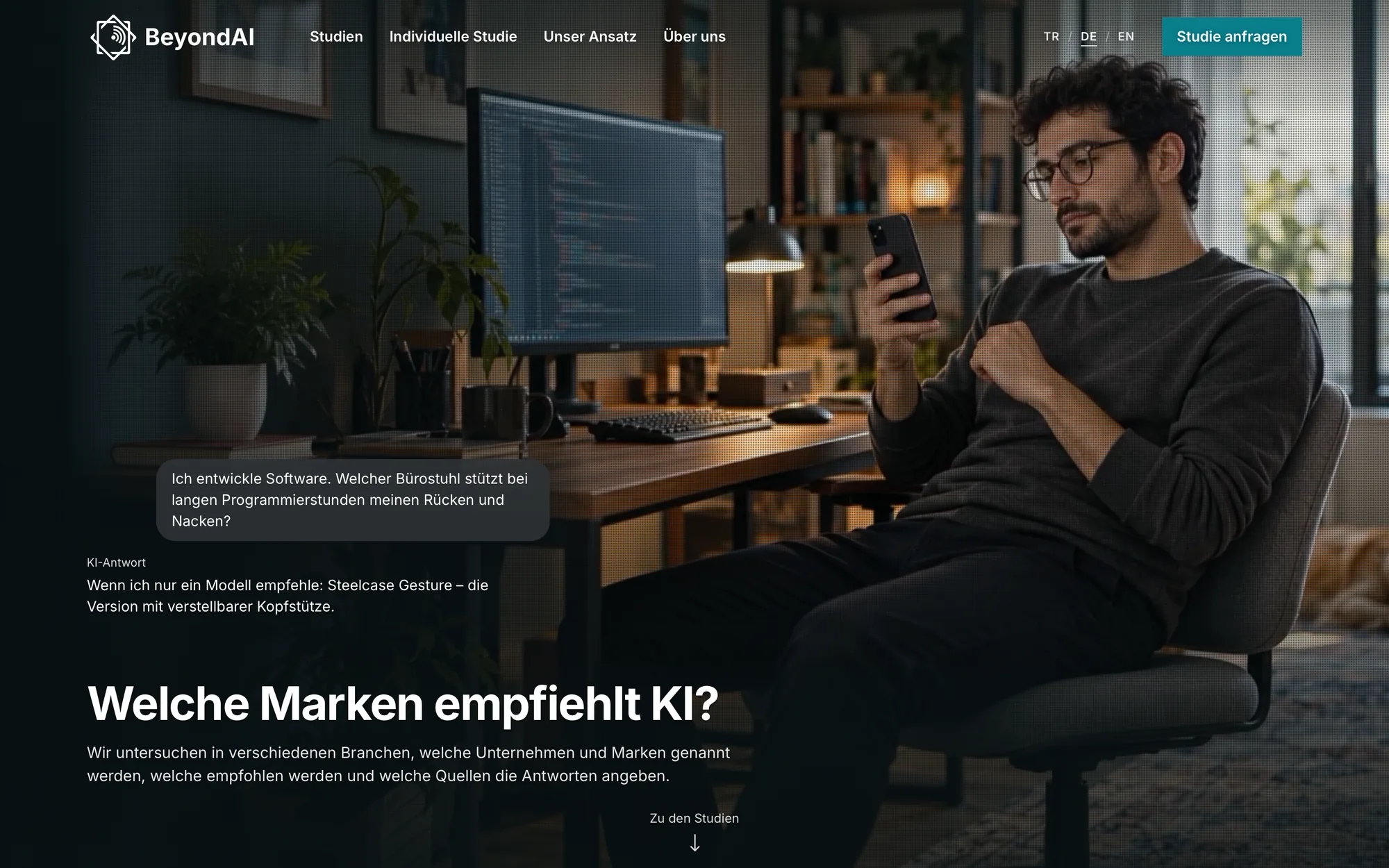
What Batunet designed and built.
BeyondAI is not a client project but a product of our own. Batunet has been responsible for it from the product idea to operation: what a study should be for readers, how it is structured, how the data gets from the research software into the portal and how a new version is made available in a controlled way.
METEGEN LEO, the research software behind the measurements, is also an in-house development by Batunet. This case study focuses on the portal.
- Product
- positioning as a study portal, structure in three reading depths, study series with dated editions, request path for custom studies
- Design
- website in three languages, charts and tables of the reports, design of the PDF reports and preview images
- Engineering
- data contract and schema validation, release store with immutable versions, publishing workflow with preview and withdrawal, PDF generation, check scripts for content, languages and build
- Operations
- delivery and ongoing operation of the portal
Two systems, one clear boundary.
Measuring and publishing are separate. METEGEN LEO, the research software developed by Batunet, asks the AI systems the questions, evaluates the answers and produces the study text, data and translations. BeyondAI takes over the approved version unchanged and turns it into study pages and PDF reports. The portal does not change the content.
Between the two sits a package contract: a study package with a fixed schema in which unknown fields are rejected. A checksum is computed from the content and carried by the preview, the website and both PDFs alike. This keeps it provable that all outputs of a version are based on the same content.
- 01
Measure
METEGEN LEO asks several AI systems the study questions and evaluates the answers.
- 02
Hand over
The study arrives as a package with a fixed schema; content, data and translations are in it, not in the portal.
- 03
Check
BeyondAI validates the package against the schema and computes the checksum of the content.
- 04
Preview
The new version is rendered as a preview without replacing the public version.
- 05
Publish
Only the checked preview is published, bound to its checksum.
- 06
Deliver
Study pages and PDFs go online from a build that has been checked beforehand.
Three reading depths for the same study.
Not every reader needs the same depth. The study overview summarises the key results on one page. The full report leads chapter by chapter through the findings, with charts, tables, method and limitations. The technical documentation discloses definitions and all evidence at the level of individual answers.
Studies form series. Each edition carries its measurement date and keeps a permanent address, so a later measurement can be placed next to the earlier one instead of overwriting it.

- Read
- study overview with key results, full report with table of contents, technical documentation with evidence
- Take away
- research report as PDF, technical documentation as PDF
- Put in context
- measurement date, target market and question language per edition, labelling of translations, labelling of AI classifications
- Repeat
- study series with dated editions, a permanent address per edition
One content, several outputs.
Every study appears as a web page and as a PDF, in three languages. If web and PDF were maintained separately, they would drift apart sooner or later, and a report whose PDF states a different figure than the website loses its credibility.
That is why all outputs are generated from the same study package. The PDFs are typeset with React-PDF from the same data as the pages, and the content checksum appears in the preview, on the website and in both PDFs. An automated comparison additionally checks whether website and PDF match in content.
The benefit is simple: whoever passes on the PDF passes on the same version that is online.
Making releases available in a controlled way.
A study is not published once and then forgotten. There are corrections, new editions and, if necessary, a withdrawal. None of these changes may leave the public site in a half-finished state.
Studies therefore live in a file-based release store, without a database: every version is stored immutably, every change is recorded in a running log, every artefact carries a checksum. Staging, preview, publishing, withdrawing and restoring are separate, traceable steps.
When publishing, the website is first built and checked as a candidate. Only then does it switch over; if a step fails, the state and the public site remain unchanged. A withdrawn study keeps its address with a notice instead of simply disappearing.
Three languages without silent translation.
A study may only go public once it is available in Turkish, German and English. Translations are created in METEGEN, not in the portal, and carry their origin: which version they come from and how they were produced. If the source text changes, the translation is considered outdated and publication is blocked.
What was measured stays visible in the original. The questions to the AI systems and quoted answers appear in the wording that was measured; translations are labelled as such. Classifications made by an AI research assistant are marked as such in every table, on the web as in the PDF.
For readers, this means every language version says what it is. A translated study does not pass itself off as a new measurement.
Travertine imports into the US.
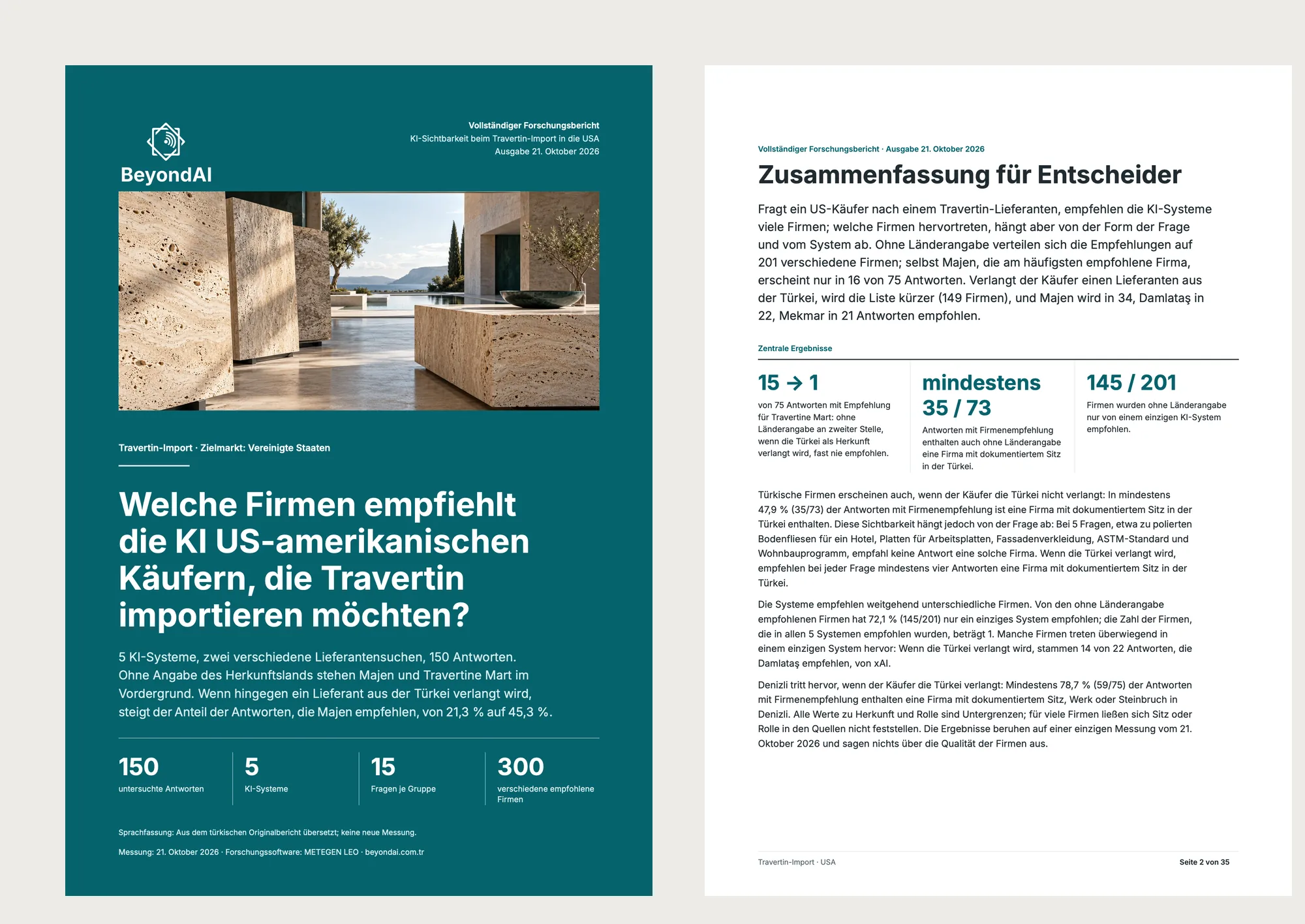
The study asks which companies a buyer in the US encounters when looking for a travertine supplier with the help of AI. On 21 October 2026, five AI systems were asked 15 questions in two forms: once without stating a country of origin, once asking for a supplier from Türkiye. 150 answers were evaluated.
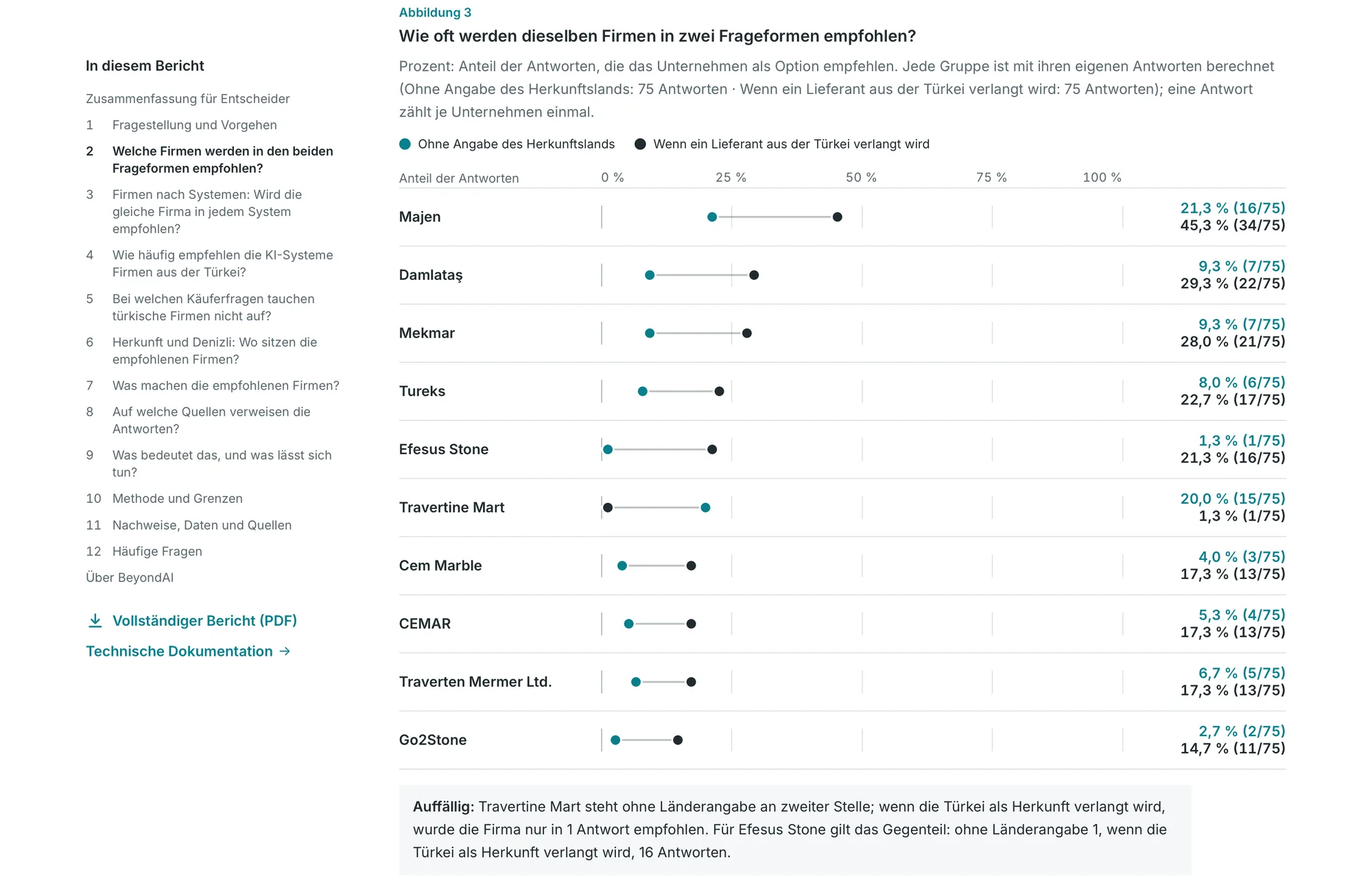
Without a country, the recommendations spread across 201 different companies, with manufacturers from Türkiye alongside dealers in the US. With the Türkiye condition, the picture shifts markedly: individual manufacturers are recommended considerably more often, while a previously frequently recommended US dealer hardly appears any more. And of the 201 companies, the vast majority were recommended by only a single system.
The study does not rate companies. It shows which companies are offered as an option in the answers, is based on a single measurement and explicitly reports origin information as lower bounds.
The state at launch.
BeyondAI has been public since 29 October 2026. At launch, eight studies are available, each in three languages, each with a study overview, full report, technical documentation and two PDFs per language. New editions and corrections go through the same checked workflow as the first publication.
What BeyondAI achieves for readers cannot be quantified seriously after a few days, so we do not try. What can be shown is the state of the product: a portal that takes over measurement data unchanged, presents it traceably in three languages and can trace every version back to its content.
Technologies used
A stack that fits the task: Next.js and React for the study pages in three languages, TypeScript throughout, Zod for the schema of the study package, React-PDF for reports and preview images, Tailwind CSS for the design. Studies are stored as files in a versioned release store rather than in a database.
Where this case connects.
Questions about this case
Is BeyondAI a client project?
No. BeyondAI is a Batunet brand. Concept, design, development and operation of the portal are ours, as is the development of the research software METEGEN LEO.
What does METEGEN LEO do, and what does BeyondAI do?
METEGEN LEO is the research software, also developed in-house by Batunet: it asks the AI systems the questions, evaluates the answers and produces the study text, data and translations. BeyondAI takes over the approved version unchanged and publishes it as study pages and PDF reports.
Do the studies say anything about the quality of the companies named?
No. What is measured is which companies AI systems name in their answers or recommend as an option. Products, prices or reliability are not assessed, and the results are not market shares.
Can a study lead to better recommendations by AI?
A study describes the state at one point of measurement. It guarantees neither mentions nor recommendations or placements in AI answers.
Why does a study portal need its own publishing workflow?
Because studies change: there are corrections, new editions and withdrawals. A versioned release store, a preview before every publication and a checked build ensure that a new version only goes public after it has been checked, and that every version can be traced back to its content.
Related topics.
Guides, decisions, services and case studies connected to this page.
Let’s talk about your project.
Tell us briefly about your project. Your first conversation is directly with our management.